
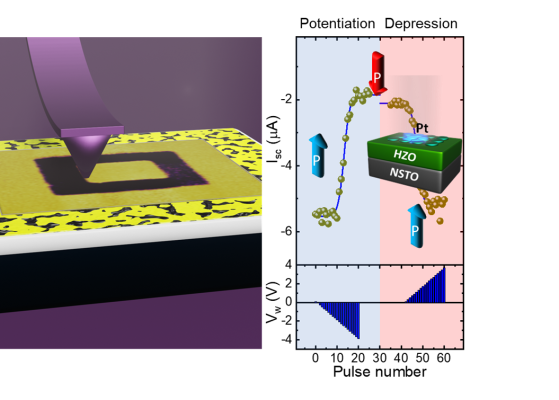
Development of light-controlled nanoelectronic systems (Mnemóshelio)
One of the certainties of this century is that the number of electronic devices—intended to help our societies address environmental, communication, health, and computational challenges—will increase dramatically. Fundamental research has already fully entered the post-Moore era, where new paradigms for integrated memory and logic functionalities are being intensively explored. However, translating this fundamental research into devices that are accessible to society requires further investigation of materials capable of performing integrated functionalities in an energy-efficient manner.
In electronic devices, a substantial fraction of energy is dissipated as heat, with an additional energy cost associated with refrigeration. This energy loss occurs during data writing, reading, transfer, and computation. Memristors are the fundamental building blocks of memory devices with logic capabilities, and their development and fundamental understanding are key to enabling new architectures with integrated functionalities. The use of devices combining logic and memory would significantly simplify the hierarchical structure of modern computing systems. Consequently, memristive devices constitute the core materials of the present project.
Memristors that can be controlled (i.e., written) by light offer a promising route to overcoming the critical issue of Joule heating, particularly in data-transfer processes, thereby further reducing power consumption. In addition, optical control can accelerate communication between different elements of electronic devices, including sensors and multiple memory and logic levels. While power dissipation during the read operation is often overlooked in fundamental research due to its lower energy cost compared with the write process, its optimization remains essential for improved device performance. In this context, photovoltaic read-out—using light to read the memory state without an applied bias voltage—will be investigated as a strategy to further enhance energy efficiency.
In summary, the ultimate goal of the project is to fabricate materials exhibiting memristive behavior that can be both optically writable and optically readable.
Funding Bodies

Ministerio de Ciencia e Innovación (Transición Energética y Digital), NextGeneration EU