
Epitaxial Thin Films of Ferroelectric HfO2 with High Polarization, Endurance and Retention (Epi-Hafnia)
Ferroelectric HfO₂ is the material best positioned for the development of a new generation of ferroelectric memories, featuring high speed and low energy consumption that outperform other memory technologies. The Epi-Hafnia project has explored new routes to improve some of the properties of this material. Epi-Hafnia has studied the material in epitaxial form as a model system to accelerate the understanding and enhancement of its properties. In particular, the project aimed to open new pathways to increase polarization and cycling endurance without degradation of retention.
The main advances achieved within Epi-Hafnia are:
I) The implementation of a new growth methodology using pulsed laser deposition combining oxygen and Ar, which has enabled the maximization of ferroelectric polarization.
II) The determination of the intrinsic effects of La doping and Zr–La codoping, carried out through the first comprehensive study based on epitaxial samples.
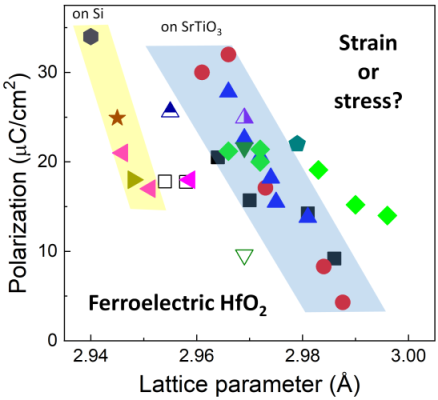
III) The demonstration of the absence of a relevant impact of crystal lattice strain on the ferroelectricity of doped hafnia.
IV) The first-time development of epitaxial nanolaminated structures of ferroelectric hafnia and the demonstration that they enable a reduction of ferroelectric fatigue.
Funding Bodies

Ministerio de Ciencia, Innovación y Universidades