
Memristive memory device array based on epitaxial ferroelectric hafnia (FEpiArray)
During the last years there is a renaissance on the interest of the scientific community and industry on the use of ferroelectric materials for memory applications. The reason has been the discovery of ferroelectricity in a simple binary oxide fully CMOS compatible, i.e. doped HfO2. The community has been mainly focused on its characterization in polycrystalline form. Recently, we have developed the growth of epitaxial ferroelectric doped HfO2 films. These show higher crystalline quality, sharper interfaces and state-of-the-art functional properties.
In the precedent project (PID2019-107727RB-I00), we have demonstrated that epitaxial ferroelectric doped HfO2 films can be used as binary memory elements. These, studies are based on ferroelectric tunnel junctions, but these present some disadvantages, f.i. their low ON/OFF contrast. It is necessary to continue the investigations of the use of memory devices based on epitaxial ferroelectric hafnium oxide but using other compositions that would help to overcome the found bottle-necks. For applications, it is necessary to advance in the nano/micro-fabrication of elements forming arrays of devices.
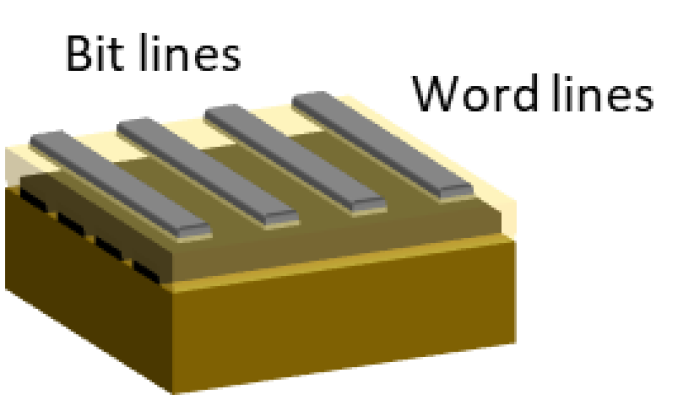
Our research stage is ideal to tackle the objective to develop and characterize a memory device based on epitaxial ferroelectric hafnia. The project aims to develop an array memory device. The array density limits imposed by the patterning of epitaxial devices will be explored. Patterning is always difficult in oxide materials and has hindered some progress up to now. ON/OFF resistance ratio will be maximized by using optimal composition as an active part in the device. Full functional characterization, including its memristive behavior, will be performed in the developed proof of concept memory device. The superior performance of the developed device based on materials of superior crystalline quality than those currently developed will attract interest from scientific and industrial communities and it will be of interest for applications. The project is full in-line with the objectives of the PERTE CHIP (PERTE de microelectrónica y semiconductores), in all the strategic actions.
Funding Bodies

Ministerio de Ciencia e Innovación, NextGeneration EU